
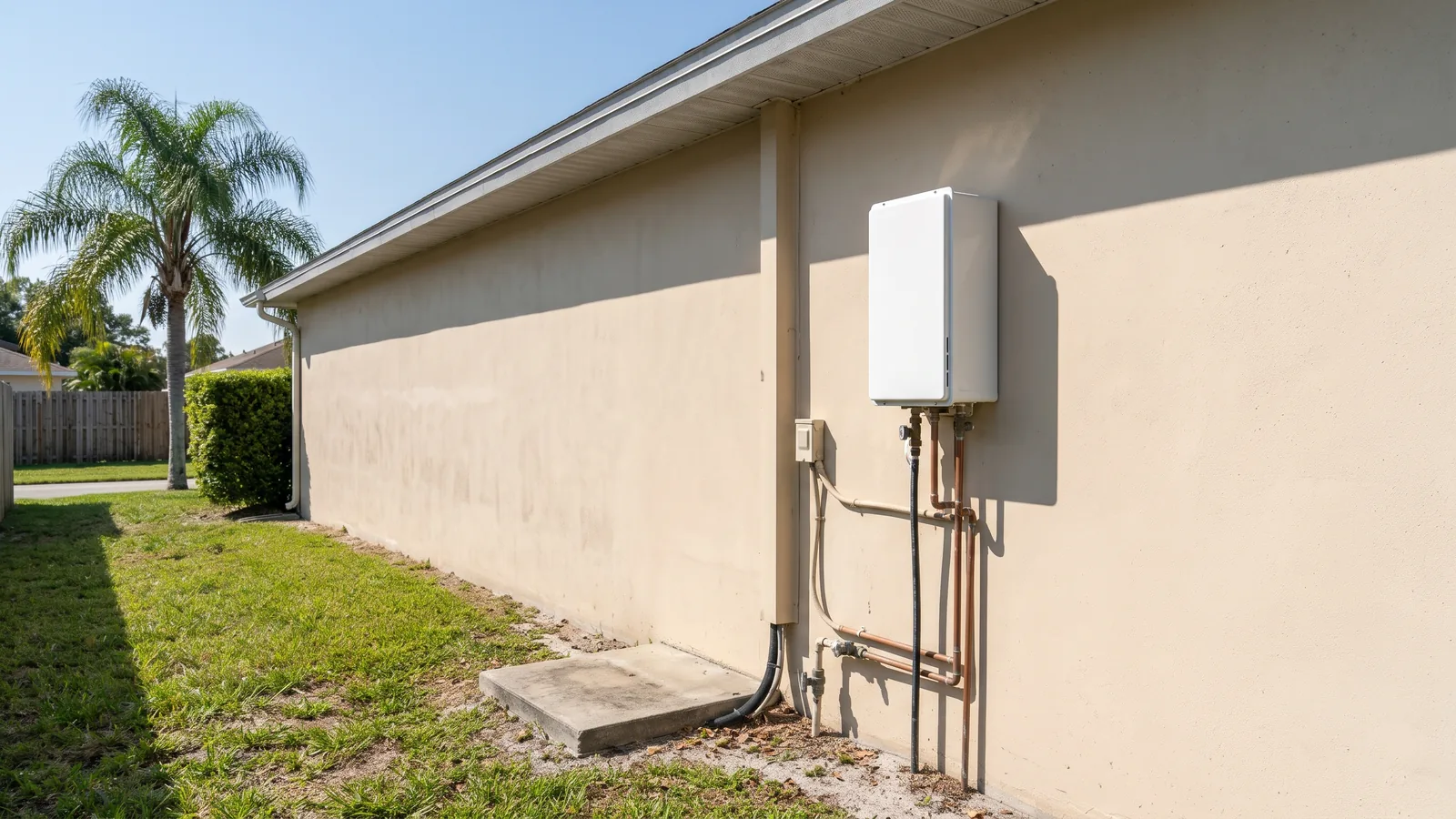
Heat Pump Water Heater Options for an All-Electric House
A heat pump water heater is a storage tank with a heat pump built in. The Department of Energy says it moves heat out of the surrounding air instead of making it, which is why it can be two to three times as efficient as a standard electric tank. It's not tankless, but it's the electric alternative when a panel can't carry a whole-house electric tankless unit.
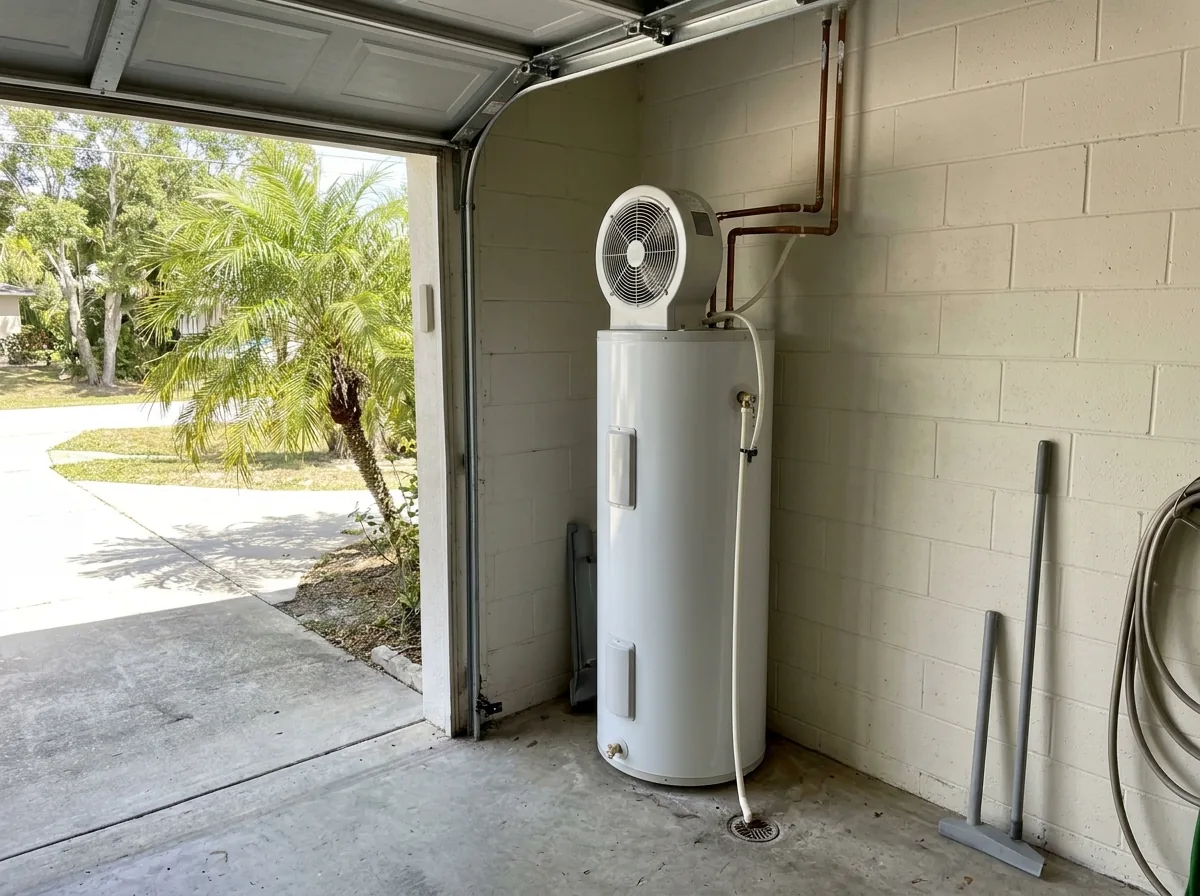
Garage Heat Pump Tanks in a Warm Climate
Warm air is what these units feed on. The DOE says any air-source heat pump works more efficiently in a warm climate, and ENERGY STAR says heat pump water heaters do best in spaces that don't regularly fall below 38°F. That suits a Port St. Lucie garage for most of the year. The other end is the open question: DOE's general guidance tops out at 90°F, while Rheem rates its plug-in to 145°F. Read the operating range on the model you're quoted. DOE also notes these heaters cool the space they're in.
- Best range per DOE: 40°F to 90°F year-round; ENERGY STAR: above 38°F
- Rheem ProTerra plug-in: rated to run in 37°F to 145°F air
- Clearance: at least 1 foot from walls and the ceiling (ENERGY STAR)
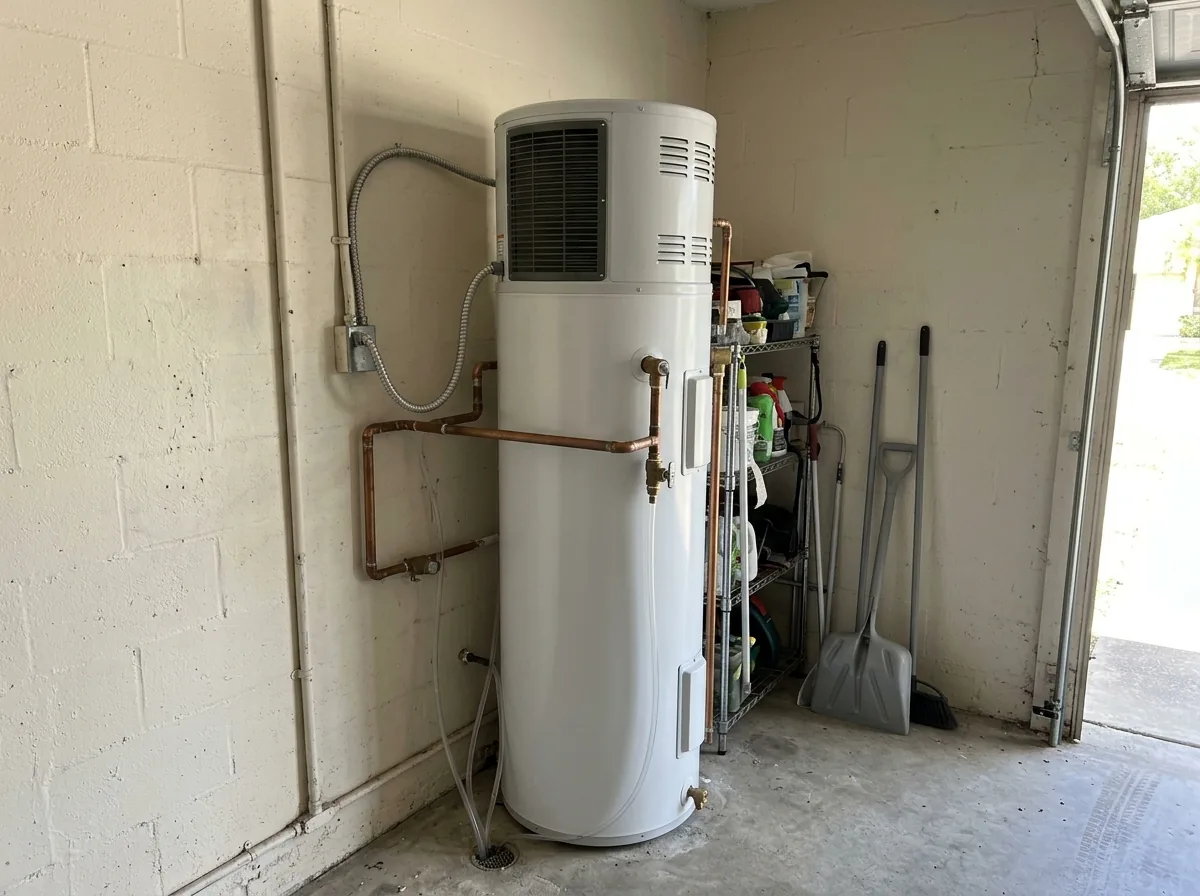
Integrated vs Split-System Heat Pump Heaters
The DOE describes two ways to buy one. An integrated unit has the heat pump, a storage tank and backup resistance elements in one cabinet. Alternatively, a heat pump can be retrofitted to work with an existing storage tank. ENERGY STAR also certifies split-system heat pump water heaters as their own category, with a lower bar: integrated units need a UEF of at least 3.30 to earn the label, split systems at least 2.20.
- Integrated: ENERGY STAR minimum UEF 3.30; first-hour rating at least 45 gallons
- Split system: ENERGY STAR minimum UEF 2.20
- Sealed-system warranty: at least 6 years for the label
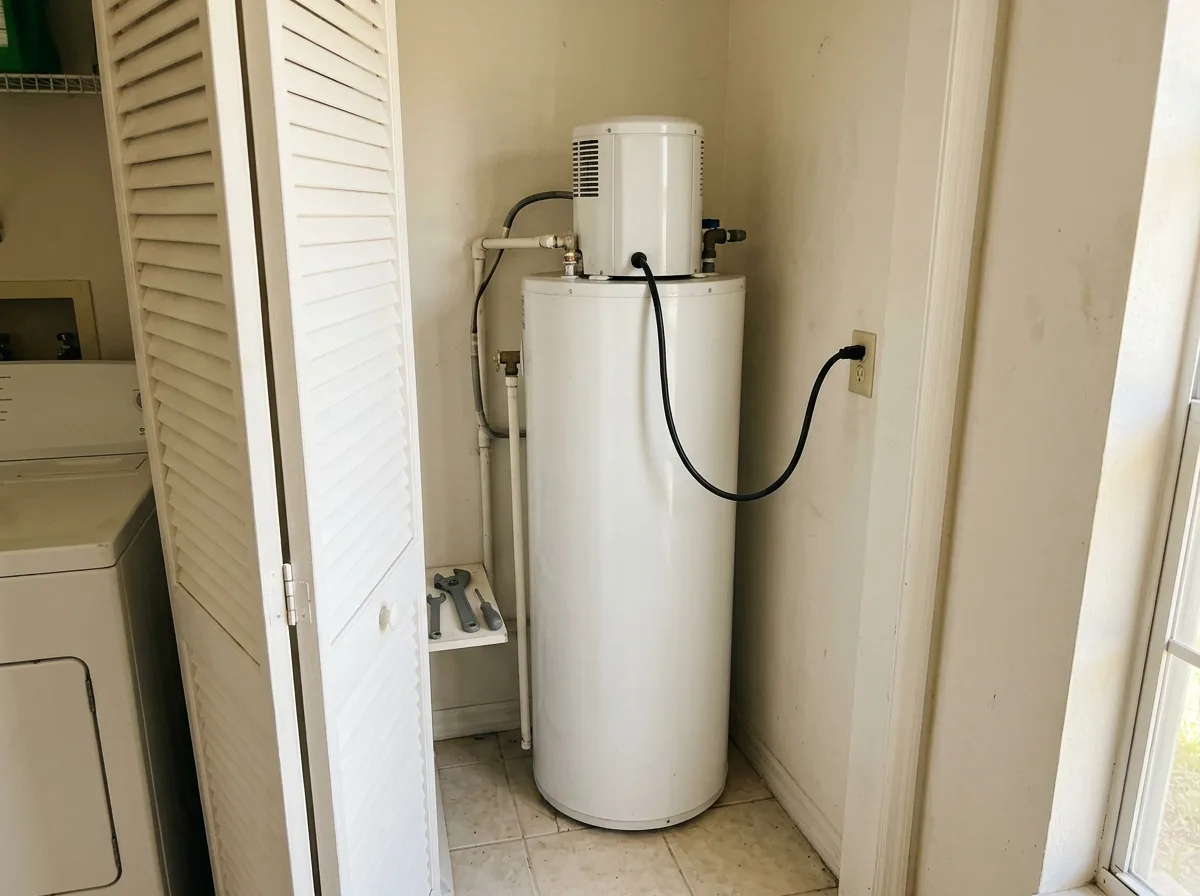
120-Volt Plug-In Heat Pump Models
Some heat pump tanks plug into an ordinary outlet. Rheem's ProTerra plug-in comes with a factory cord, runs on 120 volts and draws 1,100 watts on its own 15-amp circuit. ENERGY STAR says these models were built to replace gas tanks and usually need to be two sizes bigger than the gas unit they replace, for example 40 gallons of gas to 65 of heat pump. Some need a dedicated outlet and others can share one. Their ENERGY STAR floor is a UEF of 2.20, lower than the 3.30 for 240-volt units.
- Rheem PROPH50: 50 gallons nominal, UEF 3.0, first-hour rating 51 gallons
- Breaker: 15-amp minimum, 120 volts
- Sizing: plan two tank sizes up from a gas heater
Condensate, Airflow and Room Size Needs
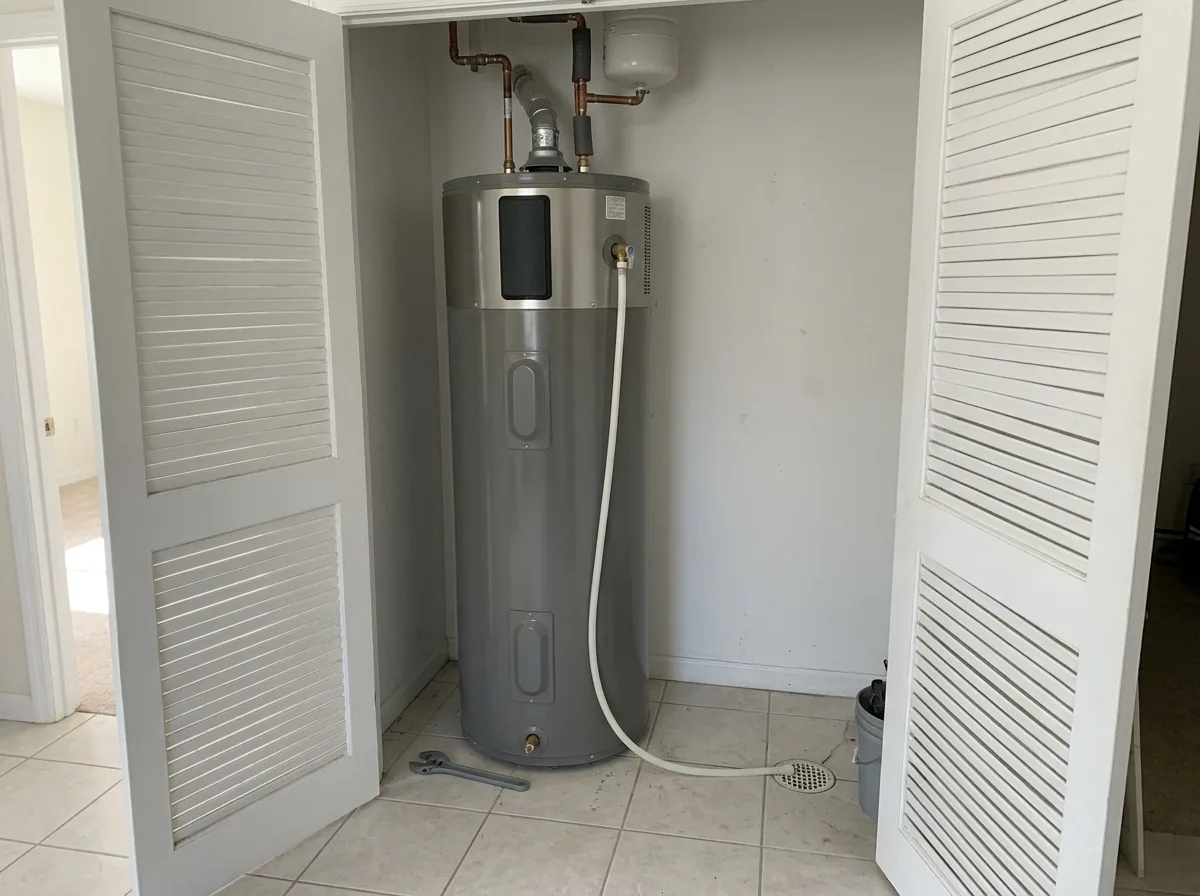
A heat pump tank makes condensate, the way an air conditioner does. ENERGY STAR describes it as a small amount of clean, non-acidic water that can go to a nearby drain or a condensate pump, and says the unit must sit level so the line drains. Florida's mechanical code requires condensate from evaporators to go to an approved place of disposal, not onto a driveway or street. Air volume is the other limit.
- Most 240-volt models: at least 700 cubic feet, such as a 10 x 10 foot room with a 7-foot ceiling; some need only 450
- Closet of at least 84 cubic feet: fully louvered door (ENERGY STAR)
- Rheem plug-in under 400 cubic feet: ducted exhaust plus a louvered door
- Recirculation: on-demand pumps only; ENERGY STAR says continuous loops strain these heaters (recirculation pumps)
Why Port St. Lucie homeowners and businesses call Port St. Lucie Tankless Water Heater
- Sending a request is free and doesn't commit you to anything
- Your details go to one licensed plumber, never a list of callers
- Ask for the unit's flow rate at your water temperature in writing
- Ask who files the city permit and books the inspection
- The referral adds nothing to the plumber's price
Heat Pump Tank or Electric Tankless on a Port St. Lucie Panel
Census figures put about 91% of Port St. Lucie homes on electric heat, so most of these jobs likely start from an electric tank. That's the case where a heat pump makes the most sense. It reuses the tank's 30-amp circuit, where a whole-house electric tankless unit may need three 40-amp breakers and a bigger service (breaker and amp load). HomeGuide's yearly running costs back up the switch: $160 to $190 for a hybrid heat pump tank, $340 to $540 for electric tankless and $530 to $600 for a standard electric tank. At FPL's current residential rate (see the electric tankless page for the sum), those gaps are real money.
A stored tank also has a hurricane-season advantage. Fixr notes that a tank keeps heated water for hours or days in an outage, while a tankless unit doesn't work at all; see power outages. The trade-offs: the tank takes floor space, it needs that air volume, and there's no federal credit for it in 2026 (tax credit status). The install still goes through the city's water heater permit.